
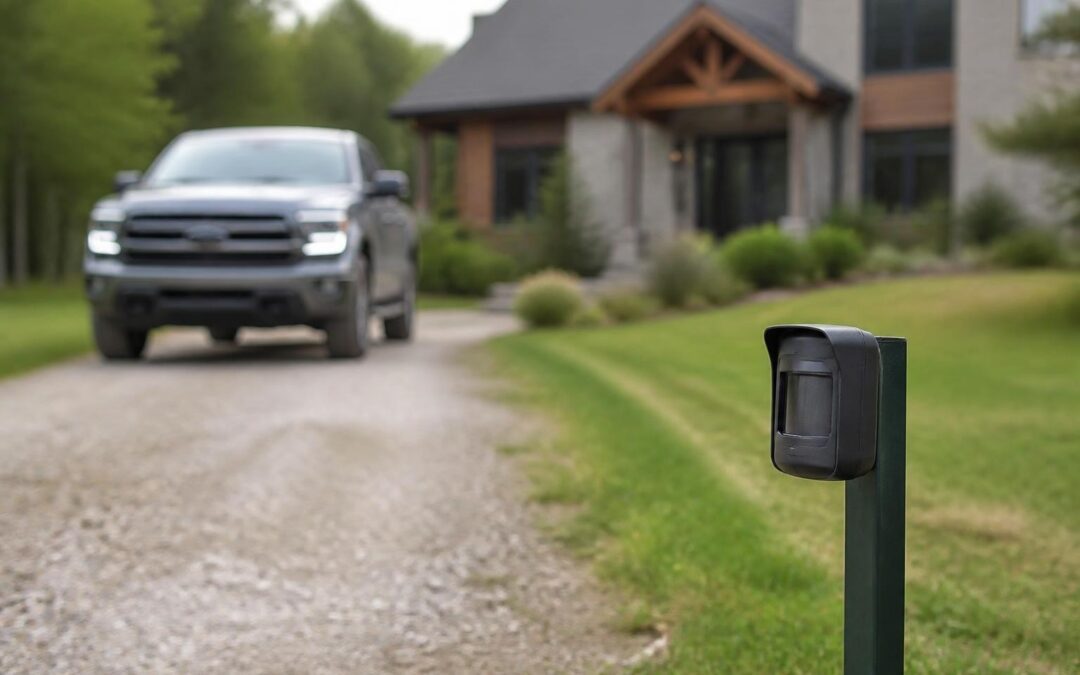
If you live on acreage in the Sunshine Coast hinterland, on a rural-residential block on Brisbane’s outer fringe, or on a larger holding on the Gold Coast hinterland, your front door probably isn’t the first line of defence for your property. Your driveway is. A standard alarm and a camera over the porch do nothing for the 200, 500 or 800 metres between your gate and your house, and that gap is exactly where most acreage owners have the least warning something is happening.
Driveway alarms and perimeter sensors close that gap. Used properly, they give you notice the moment a vehicle or person enters your property, not after they’re already at the back door.
Why Acreage and Rural-Residential Properties Are a Different Problem
Standard suburban alarm setups are built around a simple assumption: someone has to get through a door or window before the alarm knows they’re there. On a quarter-acre block with neighbours a few metres away, that’s usually enough. On acreage, it isn’t, for a few reasons that come up constantly across South East Queensland:
- Long driveways mean long delays. A vehicle turning in off the road can be at your house well before you’ve had any warning it’s coming.
- No close neighbours. There’s no one next door to notice an unfamiliar car parked near your shed or hear someone walking the fence line.
- Sheds, machinery and outbuildings sit away from the house. These are often the actual target, and they’re usually the least protected part of the property.
- Boundaries are harder to secure physically. Fencing on a few acres of bushland or pasture is rarely a serious barrier on its own.
A driveway alarm doesn’t stop any of this by itself, but it buys you the one thing suburban properties take for granted: time to respond, whether that’s you checking a camera feed, a monitoring centre acting on the alert, or simply the dog barking a few minutes earlier than it otherwise would.
How Driveway and Perimeter Alarms Actually Work
There isn’t one type of driveway alarm. The right choice depends on the length of your driveway, the terrain, and what you’re actually trying to detect (a car, a person on foot, or both).
Infrared beams
Paired infrared transmitter and receiver units are mounted either side of a driveway or access point. When something crosses the beam, it breaks the signal and triggers an alert. Beams are reliable and directional, which makes them good for a defined access point like a gate or cattle grid, but they need a clear, stable line of sight, which isn’t always straightforward on a sloped or heavily treed block.
Ground and vehicle sensors
Buried probe sensors detect the magnetic disturbance caused by a vehicle passing over them. They’re useful where you specifically want to know about vehicles rather than every wallaby or wandering cow, and they avoid the false-trigger issues that above-ground beams can run into on rural land.
Wireless PIR sensors at gate entries
Passive infrared (PIR) detectors sense movement via heat signature and are commonly mounted at the gate or the start of the driveway. Wireless units are the practical choice for acreage because running cable hundreds of metres to a front gate is expensive and often impractical. The trade-off is that wireless range and battery life need to be planned properly for the distance involved, which is where a lot of DIY driveway alarm kits fall short.
Local Considerations That Actually Matter in South East Queensland
A driveway alarm system that works well in a display home doesn’t necessarily work well on five acres in the Sunshine Coast hinterland or a rural-residential block west of Brisbane. A few things are worth planning around before you install anything:
Wildlife and false alarms
Properties backing onto bushland, state forest or grazing land deal with a constant stream of movement: kangaroos, wallabies, possums, cattle and the occasional loose dog. Motion-based sensors that aren’t correctly positioned, angled and set to the right sensitivity will trigger constantly on wildlife, and once that happens, most owners either switch the system off or start ignoring alerts altogether, which defeats the purpose. This is where correct placement and proper detection zones (rather than a generic off-the-shelf setup) actually matter.
Storm season, range and battery reliability
Wireless sensors need to hold a reliable signal back to the base unit over real distance, sometimes several hundred metres through timber, sheds or undulating terrain, and they need to keep doing it through a Queensland wet season. Storm activity, humidity and power interruptions are all things a hinterland or outer-fringe property will deal with every summer, so battery life, weatherproof housings and signal range aren’t nice-to-haves, they’re the difference between a system that works and one that quietly stops reporting after the first big storm.
Terrain and line of sight
Sloped driveways, dense vegetation and long curved access roads (common across Maleny, Montville, the Glass House Mountains area, and rural-residential pockets around Ipswich and Logan) can all interfere with beam-based systems in particular. A proper site assessment before installation avoids paying for a system that doesn’t actually cover the ground it needs to.
Integrating Driveway Alarms with Monitoring and CCTV
A driveway alarm that just makes a noise inside the house is better than nothing, but it’s not a complete solution on its own. The real value comes from integrating it with the rest of your security setup, so a triggered driveway sensor does more than beep:
- It can automatically bring up the relevant CCTV camera feed so you can actually see what triggered the alert.
- It can be linked to a monitored alarm and camera system so a genuine intrusion is picked up by a monitoring centre, not just by whoever happens to be home at the time.
- It can trigger recording on specific cameras covering the driveway and gate, rather than relying on continuous recording across the whole property.
This is the same shift a lot of newer homeowners across the region are already making with their security setups generally, moving away from standalone alarms toward systems where cameras, sensors and monitoring are designed to work together rather than as separate boxes. It’s a trend we’ve covered in more detail in our piece on how home alarm systems in Queensland are evolving with smart home integration, and it applies just as much to a five-acre rural block as it does to a new estate home.
Getting the System Right for Your Property
Every acreage property is laid out differently, so the right combination of beams, ground sensors and wireless PIR units depends on your driveway length, terrain, what wildlife activity you’re dealing with, and what you actually want covered (just the front gate, the whole boundary, or specific outbuildings and sheds). A proper site assessment is the difference between a system that reliably tells you what’s happening on your property and one that either misses genuine activity or trains you to ignore false alarms.
We’ve seen the same shift play out with new homeowners choosing integrated setups from the start rather than bolting on separate systems over time, something we go into further in why new Queensland homeowners are choosing integrated alarm and camera systems. For acreage and rural-residential properties, the principle is the same, just applied over a much larger footprint.
Dynamic Data & Security has spent over 20 years installing and servicing security systems across Brisbane, the Sunshine Coast and the Gold Coast, including a significant number of acreage and rural-residential properties where standard suburban setups simply don’t cut it. Our technicians are licensed (QLD Security Provider Licence Class 1 & Class 2) and every system is installed to Australian Standards, with manufacturer warranties and the option of dual-path monitoring so your driveway alarm is actually backed by a response, not just a notification on your phone.
If you’re weighing up perimeter security for an acreage or rural-residential property in South East Queensland, call us on 07 5453 7240 or email info@dyndata.com.au for a site assessment.
Recent Comments