
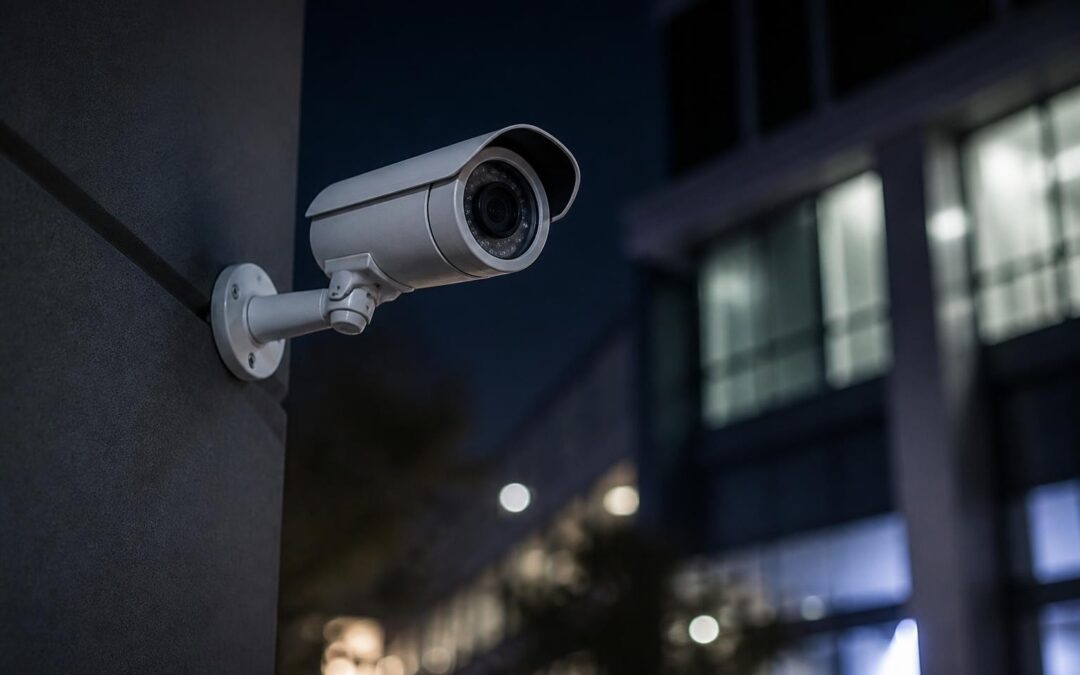
Most commercial security incidents in South East Queensland don’t happen at 2pm with the shop full of customers. They happen after close, when a warehouse is empty, a restaurant kitchen is dark, or a retail strip has gone quiet. If your cameras can’t produce usable footage in low light, you’ve effectively got no coverage for the hours when you need it most. This is where night vision technology stops being a spec sheet feature and starts being the difference between an incident that gets solved and one that just gets filed away as a loss.
If you’re weighing up options for a warehouse, bottle shop, café strip, motel or short-term rental anywhere from Brisbane down to the Gold Coast or up to the Sunshine Coast, it pays to understand what night vision cameras actually do, where each type falls short, and what genuinely changes when you’re running them in a subtropical coastal climate rather than a generic install guide written for somewhere else entirely.
Why After-Hours Coverage Carries the Load
Warehouses, hospitality venues and retail strips share a common risk profile: long stretches of the day (or night) with no staff on site, valuable stock or equipment left unattended, and entry points that are easy to approach unseen once the sun goes down. Daytime footage is rarely the problem. It’s the eight or nine hours after last trading that decide whether a camera system earns its keep. A system that looks sharp on a bright afternoon test but turns to grey mush at midnight isn’t doing the job it was bought for.
This is also where the gap between a residential-grade camera and a proper commercial installation shows up fastest. Cheaper cameras rely on basic infrared LEDs that wash out anything past a few metres, leaving you with a well-lit doorway and an unreadable car park beyond it.
Infrared, Starlight and Thermal: What’s the Actual Difference
Infrared (IR) Cameras
Standard IR cameras use built-in infrared LEDs to illuminate the scene, then capture that reflected light in black and white. They’re affordable, reliable, and perfectly adequate for entry points, loading docks and internal areas where the camera is within 15-30 metres of what it needs to see. The trade-off is range and detail at distance, plus a tendency to overexpose anything close to the lens (a moth, a hand near the camera, rain on the housing) while underexposing everything further out.
Low-Light / Starlight Cameras
Starlight (or ultra-low-light) sensors don’t rely on infrared illumination at all. Instead they use larger, more sensitive sensors to pull a usable colour image out of whatever ambient light is available, security lighting, a nearby streetlight, even moonlight. For sites where identifying a vehicle colour, a uniform, or signage matters, colour footage at night is a real advantage over black and white IR. They perform best where there’s at least some ambient light to work with, which describes most car parks, loading bays and street-facing frontages across Brisbane, the Gold Coast and Sunshine Coast.
Thermal Cameras
Thermal cameras detect heat rather than light, so they work in total darkness, through smoke, and through light fog, and they’re excellent at picking up a person moving across a large open yard, boundary fence line, or rooftop where a conventional camera would show nothing but black. They’re not built for identification (you won’t get a face or numberplate off a thermal image) but they’re very good at triggering an accurate alert that something is there. On larger industrial sites, pairing a thermal camera for perimeter detection with a standard IR or starlight camera for identification at the point of entry is a common and effective combination.
What Actually Changes in a South East Queensland Install
The length of the night doesn’t change much of the engineering here, dark is dark whether it’s Brisbane or anywhere else. What does change, and what generic installers and off-the-shelf guides tend to miss, are a handful of climate-specific factors that show up constantly in CCTV security camera installation work across this region.
- Coastal fog and moisture: Sites near the water, from the Sunshine Coast hinterland to Gold Coast beachfront strips, regularly cop overnight fog and heavy dew. IR illumination bounces straight off airborne moisture, creating a washed-out haze in the footage known as IR reflection. Camera placement and angle need to account for this, not just the model you buy.
- Insect activity around lighting: Warm, humid nights bring insects swarming around any light source, including a camera’s own IR LEDs. This is one of the most common causes of false motion alerts on poorly configured systems, sending notifications every few minutes for nothing more than moths near the lens. Correct motion zone masking and detection sensitivity settings largely solve this, but only if they’re configured for the site rather than left on factory defaults.
- Humidity and housing quality: Sustained humidity affects lens clarity and accelerates wear on lower-grade camera housings. Units rated to proper Australian Standards and backed by real manufacturer warranties hold up to a Queensland wet season in a way budget imports generally don’t.
Matching Night Vision to Your Site
The right mix of technology depends heavily on what the site actually is:
- Warehouses and industrial sites usually benefit from thermal detection along fence lines and yard perimeters, combined with starlight or IR cameras at gates, roller doors and loading bays for identification. This is covered in more depth in our piece on warehouse loss prevention across South East Queensland, where after-hours footage quality is consistently the deciding factor in whether an incident is resolved.
- Hospitality venues such as bars, restaurants and hotels need reliable coverage across car parks, back-of-house areas and street frontage once the last guests have left, often the highest-risk window of the whole day. Our guide to commercial security systems for QLD hospitality venues goes into how camera placement, lighting and staff safety considerations fit together for pubs, restaurants and hotels.
- Retail strips generally do well with starlight cameras at entries and tills for colour identification, backed by standard IR internally where ambient light is minimal.
Night Vision Is Only Half the System
A sharp night-time image is worth far less if nobody’s watching it and nothing responds when motion is detected. Night vision cameras earn their value when they’re integrated with your alarm and monitoring setup, so that a genuine after-hours event, someone on the loading dock at 3am, a forced door on a retail strip, triggers a verified alert rather than sitting unreviewed in storage until Monday morning. Dual-path monitoring means that alert still gets through even if a phone line or primary connection is cut, and an integrated system lets your cameras, access control and alarm sensors cross-check each other before anyone gets dispatched, cutting down false call-outs while making sure real ones get a fast, verified response.
Getting It Right the First Time
Night vision performance isn’t just a camera spec, it’s a combination of the right sensor technology for the site, correct placement and angling to deal with local conditions like coastal moisture and insect activity, and proper integration with monitoring so footage actually leads to a response. After 20+ years installing and servicing security systems for homes and businesses across Brisbane, the Gold Coast and Sunshine Coast, we’ve seen which combinations hold up through a Queensland wet season and which ones fail quietly until the one night it matters.
If you’re planning a new install or want an honest opinion on whether your current cameras are actually usable after dark, call our licensed technicians on 07 5453 7240 or email info@dyndata.com.au for a site assessment.
Recent Comments