Dynamic Data & Security

When businesses across South East Queensland evaluate their security infrastructure, the fundamental choice between wired and wireless often determines system performance for years to come. A wired security system uses dedicated cabling to connect cameras, sensors, alarm panels and access control devices, delivering unmatched reliability and bandwidth for commercial environments where security cannot afford drop-outs or interference. For warehouses, multi-tenant buildings, industrial sites and retail premises, the physical permanence and technical advantages of hardwired connections remain the gold standard.

Understanding Wired Security System Architecture

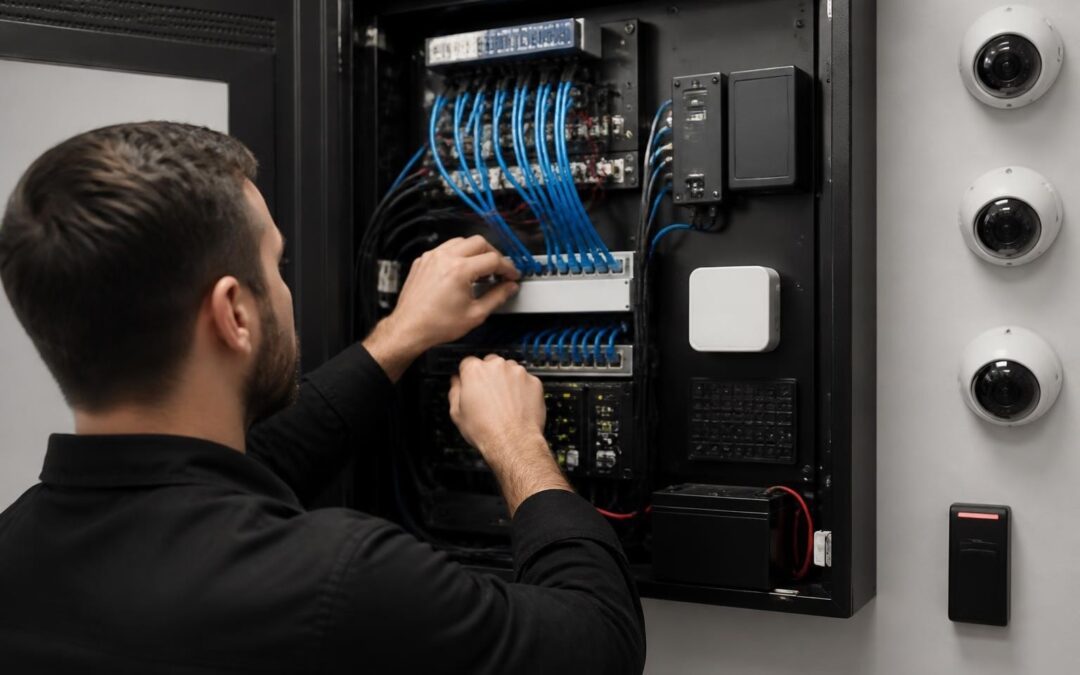
A wired security system comprises several interconnected components, each serving a specific function within the broader security ecosystem. At the core sits the control panel or network video recorder (NVR), which receives signals from field devices through dedicated cable runs.

Power-over-Ethernet (PoE) infrastructure has revolutionised how modern wired systems operate. A single Cat6 cable delivers both data and power to IP cameras, access card readers and door controllers, eliminating the need for separate electrical circuits at every device location. This dual-purpose approach simplifies installation whilst maintaining the reliability advantages of physical connections.

The typical commercial deployment includes:

  • CCTV cameras connected via coaxial (analogue systems) or Ethernet cabling (IP systems)
  • Motion detectors and door/window sensors wired to alarm control panels
  • Access control readers connected through dedicated data cables to controller boards
  • Alarm sirens and strobe lights hardwired for instantaneous activation
  • Intercom stations integrated via twisted-pair or Ethernet connections

Cable selection follows strict Australian Standards requirements. Security cabling must comply with NEC Article 760 and local electrical codes, ensuring proper separation from power circuits and adequate fire resistance. For businesses in Brisbane, the Gold Coast and the Sunshine Coast, tropical humidity and temperature extremes demand UV-resistant external cabling and properly rated conduit.

Wired security components diagram

Installation Standards and Compliance Requirements

Professional installation of a wired security system requires licensed cablers who understand both electrical regulations and security-specific standards. In Queensland, ACMA cabling licenses and security installer registrations ensure technicians possess the requisite skills for compliant deployments.

Structured cabling methodology applies the same rigorous approach used in data networks to security installations. Cable runs follow defined pathways, terminations meet TIA/EIA specifications, and documentation captures every connection point for future maintenance. This discipline prevents the rat's nest of cables that plagues amateur installations and creates ongoing support headaches.

Installation AspectStandard/RequirementBusiness Benefit
Cable certificationCat5e/6/6a tested to TIA-568Guaranteed bandwidth for high-res cameras
Fire ratingCMP/CMR plenum cables in air spacesCode compliance, insurance validity
GroundingAS/NZS 3000 earthing requirementsLightning/surge protection
LabellingUnique identifier on both endsRapid troubleshooting, easy expansion
Separation300mm minimum from AC powerEliminates electrical interference

The CISA physical security action guide emphasises that proper installation directly impacts system effectiveness. A camera mounted at the wrong height or a motion sensor placed near HVAC vents compromises detection regardless of equipment quality. Licensed installers conduct site surveys that account for coverage zones, lighting conditions, and environmental factors before pulling a single cable.

Performance Advantages Over Wireless Alternatives

Bandwidth represents the most significant technical advantage of a wired security system. A single 4K IP camera generates 8-12 Mbps of continuous data. Multiply that across 20, 50, or 100 cameras, and wireless networks quickly saturate. Gigabit Ethernet provides dedicated bandwidth to each device without contention or degradation.

Latency and reliability matter most during security incidents. When an alarm triggers or suspicious activity demands immediate review, a wired connection delivers frames without the packet loss, jitter, or dropouts that plague Wi-Fi in congested environments. For access control systems managing hundreds of card swipes daily, millisecond response times and zero failed reads depend on the consistency only physical connections provide. Industrial warehouses with metal racking, commercial kitchens with appliances generating RF interference, and multi-storey offices with concrete floors all create wireless dead zones where wired infrastructure continues performing flawlessly.

Security professionals understand that wireless networks present distinct vulnerabilities compared to their wired counterparts. Wireless signals can be intercepted, jammed, or spoofed by determined adversaries. A wired security system eliminates over-the-air attack vectors; gaining access requires physical presence and cable access, which itself becomes a monitored security event when combined with tamper detection.

Access Control Systems - Dynamic Data & Security

Signal Integrity and Distance Capabilities

Cable technology determines maximum run lengths between devices and network equipment. Understanding these limitations during design prevents performance issues after installation.

Ethernet cabling supports 100 metres between switch and endpoint when properly terminated. For larger facilities, fiber optic runs extend this to kilometres without signal loss, making wired systems practical even for sprawling industrial campuses or multi-building commercial parks.

Coaxial cable in analogue HD systems (TVI, CVI, AHD) handles 500 metres for 1080p signals, with high-quality cable pushing distances further. These extended runs eliminate the need for wireless bridges or repeaters that add complexity and failure points.

  • Cat6/Cat6a: 100m @ 1Gbps (sufficient for most IP cameras and access devices)
  • Fiber optic: 2-40km depending on mode and wavelength (campus deployments)
  • RG59 coaxial: 300-500m @ 1080p (analogue HD camera runs)
  • 18/2 alarm wire: 300m typical for sensor circuits (varies by panel specifications)

Integration with Business Systems and Monitoring

Modern commercial security demands integration across multiple subsystems. A wired security system serves as the foundation for converged physical security platforms that combine CCTV, access control, intrusion detection, and business intelligence.

Video management software (VMS) aggregates camera feeds from across multiple sites, overlaying them with access control events, alarm activations, and point-of-sale data. When every component connects through reliable wired infrastructure, the integration becomes seamless. An employee badge swipe triggers camera recording at that specific door, facial recognition algorithms process high-resolution video without compression artifacts, and incident response teams view live feeds without buffering delays.

The reliability of hardwired connections proves essential for businesses requiring 24/7 back-to-base monitoring. Monitoring centres depend on consistent alarm communication; a wireless sensor with flat batteries or signal interference creates false negatives that undermine the entire security program. Dual-path communication using wired Ethernet as the primary channel and cellular as backup ensures alarm signals reach monitoring stations regardless of internet outages.

Scalability and Future-Proofing Considerations

Installing conduit and cabling during initial construction or renovation costs a fraction of retrofit work. Forward-thinking businesses over-provision infrastructure, running extra cables to strategic locations even if devices aren't immediately installed.

A well-designed wired security system accommodates technology evolution without replacing infrastructure. Analogue cameras upgrade to IP models using the same Cat6 cables. Access control readers swap from 125kHz proximity to 13.56MHz smartcard technology without rewiring. The international IEC 62676 CCTV standards ensure interoperability between manufacturers and technology generations.

Security system expansion planning

System Growth ScenarioWired Infrastructure AdvantageWireless Limitation
Adding 10 camerasConnect to existing PoE switch portsMay require mesh network expansion, bandwidth reduction
Upgrading to 4K resolutionExisting Cat6 supports higher bitrateOften requires 5GHz upgrade, may exceed backhaul capacity
Multi-site integrationFiber links create unified networkVPN tunnels add latency, complexity
Long-term archive storageGigabit LAN supports fast NAS transferLimited by wireless backhaul speed

Cost Analysis and Total Ownership Considerations

Initial installation costs for a wired security system typically exceed wireless alternatives due to cabling labour and materials. However, total cost of ownership over a system's 10-15 year lifespan reverses this calculation significantly.

Maintenance requirements differ drastically between technologies. Wired devices require minimal ongoing service beyond occasional cleaning and firmware updates. Wireless components demand battery replacements, signal strength monitoring, and troubleshooting of intermittent connectivity issues that consume technician hours and disrupt operations.

For a 50-camera commercial installation, consider these realistic five-year costs:

  • Wired system: $45,000 installation + $2,500 annual service = $57,500 total
  • Wireless system: $32,000 installation + $6,800 annual service/batteries/connectivity = $66,000 total

These figures account for the hidden costs of wireless: site survey RF analysis, wireless controller licensing, battery replacement across dozens of devices, and the productivity loss when cameras drop offline during critical moments.

Certification and Compliance Value

Commercial premises, body corporates, and businesses handling sensitive data increasingly require UL-certified security equipment. UL 2610 covers premises security units, whilst UL 294 addresses access control systems. Wired installations more readily achieve certification because the controlled environment of physical cabling eliminates variables that complicate wireless certification.

Insurance providers recognize this reliability differential. Premium discounts for professionally installed, monitored security systems often specify hardwired components. The physical security considerations outlined by SANS Institute emphasise that wired infrastructure demonstrates security investment seriousness that wireless alternatives may not convey to underwriters.

Cybersecurity Implications for Network-Connected Systems

IP-based wired security systems connect to corporate networks, creating potential pathways for cyber threats if improperly configured. Understanding network security fundamentals becomes essential for any business deploying network-connected cameras and access control.

Network segmentation isolates security devices onto dedicated VLANs separate from general business traffic. This architecture contains potential compromises whilst allowing authorized personnel to access camera feeds and alarm interfaces through controlled access points.

The FTC guidance on securing security cameras applies equally to commercial deployments. Default passwords must be changed immediately, firmware updates applied promptly, and unnecessary services (Telnet, UPnP, etc.) disabled. A wired security system's advantage here lies in physical network access control; attackers cannot simply park outside and probe wireless signals.

Key cybersecurity practices for wired IP security systems include:

  1. Dedicated security appliance subnet: Prevent lateral movement from compromised devices
  2. Strong authentication: Enforce complex passwords, consider two-factor authentication for VMS access
  3. Encrypted communication: Enable TLS for camera streams and control protocols
  4. Regular firmware updates: Patch known vulnerabilities in cameras, NVRs, and access controllers
  5. Audit logging: Monitor who accesses security footage and when

Enterprise security teams increasingly deploy intrusion detection systems (IDS) to monitor security device network traffic for anomalous behavior. A camera suddenly communicating with an external IP address or an access controller generating unusual DNS queries triggers alerts for investigation.

Design Considerations for Commercial Applications

Retail environments, warehouses, office buildings, and industrial facilities each present unique requirements that influence wired security system design. Professional installers conduct detailed site assessments before proposing solutions.

Coverage zone analysis determines camera placement, sensor locations, and access control chokepoints. A warehouse requires wide-angle cameras at high mounting points to monitor aisles, whilst retail needs focused coverage on POS terminals and high-value merchandise. Access control for office buildings concentrates on building entry, elevator lobbies, and sensitive departments; industrial sites add vehicle gates and shipping docks.

Environmental factors significantly impact component selection and installation methodology:

  • Temperature extremes: Industrial freezers require rated cameras and heaters; outdoor tropical climates demand weatherproof housings
  • Lighting conditions: Low-light areas need cameras with excellent low-lux performance or supplemental IR/visible illumination
  • Vibration and impact: Manufacturing environments require vandal-resistant housings and secure mounting
  • Explosive atmospheres: Hazardous locations demand intrinsically safe devices and specialized conduit

Integration with Building Management Systems

Sophisticated commercial facilities integrate security with HVAC, lighting, and elevator control through building management systems (BMS). A wired security system using standard protocols (BACnet, Modbus, ONVIF) connects seamlessly to BMS platforms.

This integration enables powerful automation scenarios. An after-hours intrusion alarm automatically illuminates affected zones, locks down elevator access, and notifies security teams with camera footage of the breach point. During business hours, the BMS disarms specific zones when climate control activates, reducing nuisance alarms from HVAC-induced motion.

For multi-tenant commercial properties, integration allows property managers to centrally monitor common areas whilst providing tenants with isolated systems for their leased spaces. Hardwired infrastructure clearly delineates system boundaries and prevents signal bleed between tenants that wireless deployments struggle to contain.

Commercial security integration workflow

Professional Installation Benefits and Warranty Protection

Licensed security installers bring expertise that extends beyond simply connecting cables. Their site-specific knowledge prevents the common pitfalls that compromise amateur installations and void equipment warranties.

Manufacturer warranties typically require professional installation by licensed technicians. HikVision, Avigilon, and other enterprise-grade security brands offer extended warranties and technical support only when their equipment is deployed by authorized partners. DIY installations sacrifice this protection, leaving businesses liable for equipment failures and compatibility issues.

Professional installers also carry appropriate insurance coverage. Public liability and professional indemnity policies protect businesses from installation damage, whilst workers' compensation ensures injured installers don't become a liability claim against the property owner. These protections matter significantly during multi-day commercial installations involving ceiling work, conduit runs through walls, and equipment mounting at height.

The troubleshooting advantage becomes apparent when systems malfunction. Licensed installers systematically diagnose issues using proper test equipment (cable certifiers, PoE testers, multimeters), isolating faults to specific components or cable runs. They maintain relationships with equipment suppliers for warranty returns and access to technical support that consumer-grade equipment buyers never receive.

Maintenance and Lifecycle Management

A properly installed wired security system requires minimal maintenance compared to wireless alternatives, but regular servicing maximizes lifespan and ensures ongoing reliability. Developing a structured maintenance schedule prevents minor issues from escalating into system failures during critical moments.

Quarterly inspections should verify:

  • Camera lens cleanliness and focus accuracy
  • Sensor functionality and proper zone coverage
  • Access control reader responsiveness
  • Alarm panel battery backup capacity
  • Network switch port status and PoE power delivery
  • NVR/DVR hard drive health and recording continuity

Annual comprehensive service includes firmware updates across all devices, testing of backup communication paths, and physical inspection of cable terminations for corrosion or loosening. For businesses in coastal areas of the Gold Coast and Sunshine Coast, salt air accelerates connector degradation; scheduled inspection catches these issues before they cause failures.

Documentation maintains its value throughout the system lifecycle. As-built drawings showing exact cable routes and termination points enable efficient troubleshooting and expedite expansions. Network diagrams detailing IP addresses, VLANs, and switch port assignments prevent the configuration confusion that wastes hours during service calls.

Technology Refresh Planning

Security technology evolves rapidly, with camera resolution, analytics capabilities, and access control features advancing continuously. A well-designed wired infrastructure supports technology refresh without complete replacement.

Budget-conscious businesses can upgrade incrementally, replacing analogue cameras with IP models as they fail rather than simultaneously swapping the entire system. The structured cabling supporting those cameras serves both technologies during transition periods. Access control systems similarly allow reader upgrades to newer credential types whilst retaining existing door controllers and wiring.

Planning technology refresh cycles around business depreciation schedules makes financial sense. Most commercial security equipment depreciates over 7-10 years for tax purposes; aligning replacement with depreciation completion optimizes capital expenditure timing whilst ensuring contemporary security capabilities.


A wired security system represents a long-term investment in reliable, scalable physical security that grows alongside your business operations. From single-location retail to multi-site industrial operations across South East Queensland, the technical advantages of dedicated cabling deliver performance wireless simply cannot match. Dynamic Data & Security has spent over two decades designing and installing wired security infrastructure for businesses throughout Brisbane, the Gold Coast, and the Sunshine Coast, bringing licensed expertise and industry-leading brands like HikVision to every project. Whether you're protecting a single storefront or securing an entire commercial campus, our team builds systems around how your business actually operates-contact Dynamic Data & Security today for a comprehensive site assessment and customized security solution.