
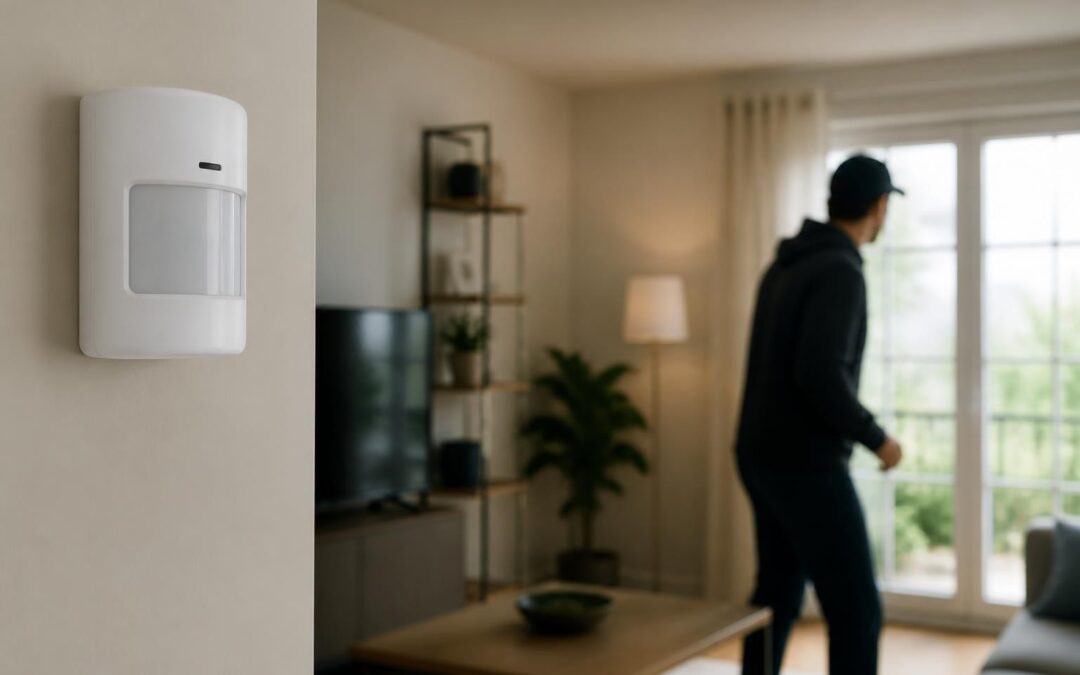
If you’re weighing up a wireless motion sensor alarm for a home or business in South East Queensland, there’s more to think about than what you’d find in a generic buying guide. Our climate is hot, humid and bug-heavy for most of the year, and that changes how motion sensors perform, how often they false-alarm, and how long their batteries actually last. This guide covers how the sensors work, the difference between indoor and outdoor-rated units, pet-immune options for Queensland’s dog and cat-owning households, and the local quirks that catch people out.
Wireless motion sensors are usually the backbone of a residential alarm, and increasingly a core part of small business security too. Get the sensor choice and placement right and the system is quiet, reliable and does its job. Get it wrong and you end up with an alarm nobody trusts, which defeats the purpose entirely.
How PIR Motion Sensors Actually Work
Most wireless alarm sensors on the market use Passive Infrared (PIR) technology. The sensor doesn’t emit anything itself, it passively watches for changes in infrared heat within its field of view. A person walking through a room has a body temperature that contrasts with the surrounding air and furniture, and that contrast is what trips the sensor.
PIR sensors are broken into zones inside a lens, and movement has to cross between those zones to register as a trigger, which is why a sensor pointed at a wall or a static heat source generally stays quiet. Wireless versions communicate back to the alarm panel over a radio frequency rather than a cable, which makes them far quicker and cheaper to install, particularly in an existing home where running cable through brick veneer or timber-and-tin construction is a real hassle.
Indoor vs Outdoor-Rated Sensors
Not every motion sensor is built for the same environment, and this is one of the most common mistakes we see in DIY installs.
- Indoor sensors are designed for stable temperatures and no direct weather exposure. They’re not sealed against moisture and will fail early, or false-alarm constantly, if fitted under an eave or in a garage that gets wind-driven rain.
- Outdoor-rated sensors carry an IP rating for dust and water resistance, use tighter detection logic to ignore small animals and blowing vegetation, and are built to handle temperature swings between a 40-degree afternoon and an overnight change.
For Queensland properties with verandas, alfresco areas, pool zones, sheds or driveway approaches, outdoor-rated sensors aren’t optional extras, they’re what stops the whole system becoming unreliable.
Pet-Immune Sensors for Queensland Homes
A huge number of homes across Brisbane, the Gold Coast and the Sunshine Coast have a dog or cat that has the run of the house, or at least part of it, overnight. Standard PIR sensors will happily trigger on a medium-sized dog wandering the lounge room at 2am, which trains homeowners to either disarm the system before bed or ignore the alerts altogether. Neither is a good outcome.
Pet-immune sensors use a combination of lens design and weight-based logic (commonly tuned to ignore movement under roughly 20-40kg, depending on the model and mounting height) to filter out cats and dogs while still catching a person. They’re not foolproof for a Great Dane standing on its hind legs on the couch, and mounting height and angle matter, but for the vast majority of households they solve the false-alarm problem without leaving a gap in coverage. This kind of filtering is part of a broader shift toward alarm systems that behave more intelligently around how people actually live, something we’ve written about in more depth in our piece on how home alarm systems in QLD are evolving with smart home integration.
Why South East Queensland Conditions Trip Sensors Up
A motion sensor that performs perfectly in a display home in a drier climate can behave very differently once it’s living through a Brisbane summer. There are three specific issues we see repeatedly on service calls.
False Alarms From Insects and Spiders
Cockroaches, moths and spiders are far more active in SEQ than in cooler, drier states, and they love the warm cavity behind a sensor’s lens. A spider building a web directly across the lens, or an insect walking over it, can register as movement and trigger a false alarm. Outdoor and garage-mounted sensors are the most exposed to this. Regular lens checks and choosing sensors with insect-resistant housings cuts this down significantly.
Humidity and Lens Fogging
Coastal humidity, especially through summer storm season, can cause condensation to form inside a sensor housing that isn’t properly sealed, fogging the lens and either blinding the sensor or causing it to misread temperature changes as movement. This is far less of an issue inland or in cooler states, but it’s a genuine and recurring problem for properties near the coast on the Gold Coast and Sunshine Coast in particular. A properly sealed, quality outdoor-rated sensor with a well-fitted housing largely avoids it.
Heat and Battery Life
Wireless sensors run on batteries, and battery chemistry degrades faster in sustained heat. A sensor mounted in a north-facing eave or a hot roof cavity in Queensland will typically chew through its battery noticeably faster than the same sensor in a temperate climate, meaning shorter replacement intervals than the manufacturer’s headline figure might suggest. Factoring this into your maintenance schedule (rather than waiting for a low-battery alert during a storm) is worth doing from day one.
How Sensors Connect to Back-to-Base Monitoring
A motion sensor on its own only makes noise. What actually protects a property is what happens after it triggers. With back-to-base monitoring, a genuine detection is sent through to a monitoring centre, where it can be verified (often alongside a camera view or additional sensor activity) before a response is initiated, whether that’s a phone call, a keyholder callout or dispatching help. Pairing well-chosen, correctly placed sensors with dual-path monitoring is what turns “an alarm went off” into a system that actually does something about it, rather than a siren that a neighbour eventually calls to complain about.
Where Wireless Sensors Fit Into a Complete System
Motion sensors rarely work best in isolation. In a well-designed setup they sit alongside door and window contacts, CCTV cameras that can confirm what triggered a zone, and for businesses, access control that manages who can get in and when. For a retail unit, warehouse or office, a monitored alarm with motion sensors covering after-hours zones is often paired with cameras and access logging, an approach we cover in detail in our guide to security alarm systems for business with 24/7 monitoring.
Whether you’re protecting a family home, a holiday rental sitting empty half the year, or a commercial site, the right combination of sensor type, placement and monitoring makes the difference between a system you trust and one you end up switching off. If you want it assessed properly for your specific property, our team can walk through your options as part of a broader security systems install across Brisbane, the Gold Coast or the Sunshine Coast. Call 07 5453 7240 or email info@dyndata.com.au to talk it through.
Recent Comments